





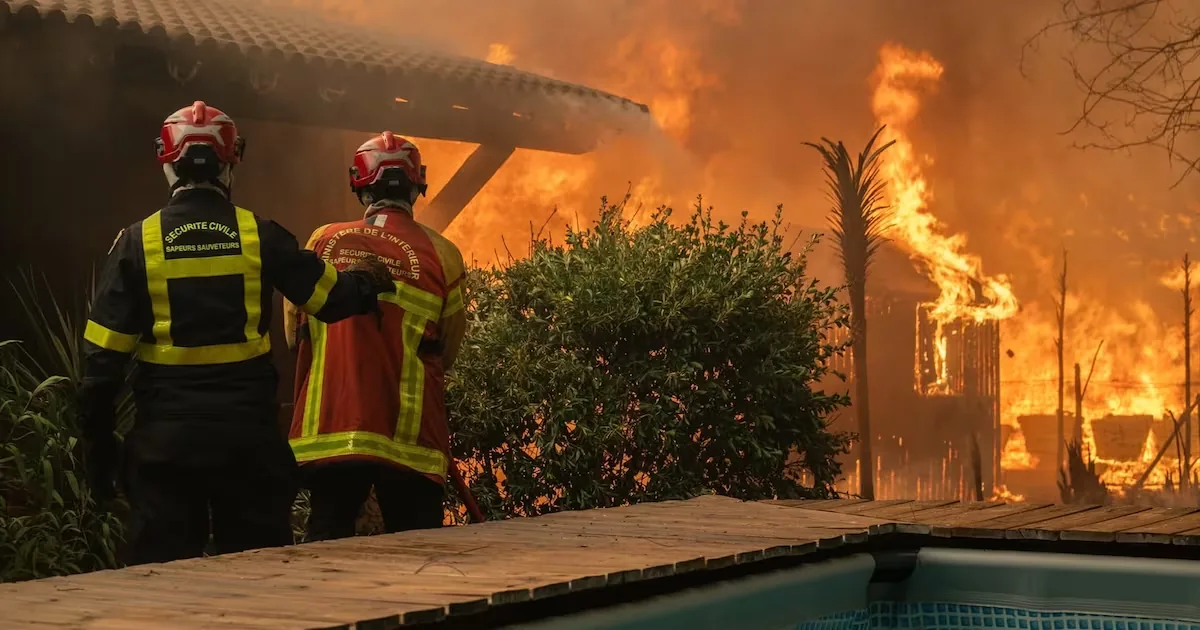
More than 330,000 people have left their homes on both sides of the Pyrenees due to wildfires affecting southwestern France and several regions of Spain. Around a dozen countries contributed planes, helicopters, and firefighters to reinforce operations of exceptional magnitude, according to official figures released by both countries.
Read more Matucana 100 opens its stage to new Chilean music
The fire has been advancing in parallel in both Western European countries since last week, driven by forests and dry scrubland due to the high temperatures of the boreal summer.
In this context, French and Spanish authorities agreed this Monday that the progress made overnight is limited and that the expected rise in temperatures in the coming days could worsen the situation.
On one hand, French President Emmanuel Macron chaired a crisis cabinet on Monday for the firefighting operation in the southwest of the country. The flames have burned an area four times larger than Paris and forced 220,000 people to flee.
Macron described the situation as the worst fire-related crisis in France since World War II. “We are facing a completely unprecedented fire,” he said.
The president praised the teams that stopped the fire’s advance on Monday after consecutive days of spread, although he warned that the battle is not won while the forests continue to smoke. “The coming weeks will be tough,” he noted. In his message to the firefighters, he asked them to “stay strong” and made a promise. “We will win this battle together,” he said.
Regional authorities indicated that the situation overnight until Monday remained “generally stable,” according to the same source. Days earlier, the flames had approached up to 15 kilometers from the outskirts of Bordeaux, a city of 268,000 inhabitants, and generated firestorms with lightning that caused new outbreaks. No new evacuations were announced on Monday.
The French operation relies on thousands of firefighters on the ground and rotations of aircraft dropping water and retardants. Teams with heavy machinery removed strips of forest and scrub to create vegetation-free spaces to stop the spread, while farmers supplied water to the brigades with tanks.
According to the Los Angeles Times, the immediate concern is to anticipate the effects of a heat wave. The national meteorological service forecast temperatures above 35 °C in the southwest on Tuesday and probably higher values on Wednesday.
Additionally, France is about to enter August, its peak tourist season, and authorities in the Gironde region around Bordeaux worked to keep vacationers away. As part of these measures, they banned holiday camps for children and people with disabilities.
In Spain, the fires burned out of control around Madrid and Valencia. Authorities have evacuated at least 79,000 people and confined another 30,000 to their homes.
In response to the crisis, Spanish Prime Minister Pedro Sánchez admitted this Monday that “difficult, complex hours remain” to combat the active fires, which have burned at least 85,000 hectares in recent days, according to Infobae. Sánchez emphasized that it is a “priority” to defend “people’s lives, population centers, and fight the fire,” and asked the public for “patience and understanding.”
The head of government visited the advanced command post of the fire in the province of Castellón, in the east, where the fire burned at least 7,200 hectares and 16,000 people remained evacuated, in addition to 64,000 confined.
To that area are added nearly 80,000 hectares destroyed by fires in Ávila, Madrid, and Toledo, in the center of the country, where the government declared a national emergency and is directing control and extinguishing operations. In Ávila alone, at least 50,000 hectares burned, the largest forest fire recorded in Spain, according to official data.
That fire, advancing in mountainous and rural terrain west of Madrid, covers 500 square kilometers, five times the size of Barcelona.
In Madrid, at least 25,000 hectares are damaged and 2,000 in Toledo. More than 92,000 people from these three provinces remained evacuated or confined in their homes for safety. Interior Minister Fernando Grande-Marlaska confirmed in Navalcarnero, Madrid province, that forecasts are “really negative” with the temperature rise starting Wednesday, so Monday and Tuesday were “crucial” to advance control work, a task he described as slow.
Minister for the Ecological Transition, Sara Aagesen, had reported a “positive evolution” of the fires in recent hours, although she stressed that the situation is “very complex,” in statements to Radio Nacional de España. The year’s balance confirms the magnitude of the problem. Wildfires burned 172,396.10 hectares in Spain between January 1 and this Monday, July 27, nearly 20,000 hectares more than the provisional data from Sunday. The total destroyed area is almost six times higher than the 29,817 hectares in the same period of 2025, according to the latest update from the Ministry for the Ecological Transition.
The exceptional scale of the fires in Spain and France was fueled by heat waves that struck strongly and early this year, leaving forests and scrub dry as tinder.
This combination reactivated calls in both countries for more forceful action against climate change. Sánchez directly linked the fires to this emergency. “What we are experiencing is not a succession of isolated episodes, it is the most painful expression of a climate emergency that makes fires (…) more voracious, heat waves more frequent, and our territories consequently more vulnerable,” said the Spanish prime minister.
The fight against the fire relied largely on international cooperation. Around a dozen countries provided planes, helicopters, firefighters, and other assistance to both France and Spain. In total, the fires in both countries forced more than 330,000 people to flee.
Both governments face a common factor of a new heat wave expected from Tuesday—the fourth so far this year in Spain—which could increase the danger.
The Spanish meteorological agency forecast temperatures above 40 °C. In France, the forecast of values above 35 °C starts a race against time before the heat complicates the fight against the flames again.
David González, a 48-year-old gardener who used his van to deliver supplies to firefighters in Ávila, expressed the anger and helplessness of neighbors seeing the valley and houses burned, according to his testimony collected by the Los Angeles Times.
Moreover, the crisis is not limited to the Iberian Peninsula and southwestern France. On Sunday afternoon, a fire driven by strong winds broke out near Peschici, in the Italian region of Puglia.
The fire forced the evacuation of about 300 tourists from beaches and campsites, whom the Coast Guard transported by sea to nearby Vieste, where temporary shelters were opened. Three Canadair planes and ground teams were still fighting the flames on Monday, which recalled the fires that hit that same coastal area in 2007, according to the same source.
Read more Columpios al Suelo releases «Starry Night» their new single