






The Odyssey, one of the most anticipated films of the year, arrived this Wednesday on French screens (and last Thursday in Chilean theaters).
Read more The debate opens in Germany to allow retail businesses to open on Sundays
Led by a constellation of American stars, with Matt Damon at the forefront as Odysseus (alongside Zendaya, Tom Holland, and Charlize Theron), this monumental adaptation bears the imprint of British filmmaker Christopher Nolan, Oscar winner for Oppenheimer and director of the Batman: The Dark Knight trilogy. In this film, he adapts this mythological epic with the codes of major box office hits. Below is the interview by Sophie Torlotin, a journalist from RFI, which Culto may reproduce.
–The Odyssey is a Greek poem by Homer written over 2,700 years ago. What fascinates you so much about this story?
In Homer’s The Odyssey, universal and timeless truths are found. This fundamental work of world literature is at the origin of all Western culture. This poem has fascinated generation after generation for nearly 3,000 years because it is simple and possesses those accessible and timeless qualities of human nature. Our human concerns have not changed that much.
-Why might it interest the general public in the 21st century?
When adapting it, I realized there were themes and narrative models that resonated with my previous films. For example, the story of returning home is something I had already addressed in Inception and Interstellar. In the Batman: The Dark Knight trilogy, we also find the theme of the hero’s journey. It is its simplicity and its approach to human nature that allow each generation to interpret it in a way relevant to their time.
-It is a great adventure story, with fantastic elements, monsters, but you turn it into something very realistic. Is this a deliberate realism?
Realism is a loaded term in cinema. However, I wanted the film to have a realistic texture so that viewers would believe in the story. But it was a challenge: how to approach the fantastic elements? In the case of the Trojan horse, I thought about how it could have worked in real life. My audience and I know the horse is full of Greeks, so it had to be “made believable” somehow. My solution was to think that if it looks like a fallen monument, half-buried in the sand and about to be destroyed by the sea, it doesn’t seem designed to be transported inside the city. The same happened with the Cyclops, filming in a real cave and looking for concrete solutions. As my friend Guillermo del Toro has well shown, a monster is never just a monster. But if you manage to express its emotions, you start to believe in it; it gains weight and gravity, and then it becomes threatening and terrifying because it seems real.
-You have made a science fiction film, Interstellar; superhero films, Batman; a war film, Dunkirk. This time, did you want to delve into another genre: the peplum, also called historical epic cinema or “sword and sandal” cinema?
I took as reference great epic films like Lawrence of Arabia, Gladiator, or Barry Lyndon. But there had not been a modern retelling of Greek mythology. Directors like Ray Harryhausen had tackled it, but with budgets and resources typical of B-movie productions. Having the opportunity to do this for the first time on a large scale, with a significant budget and cast, is a unique opportunity for a director.
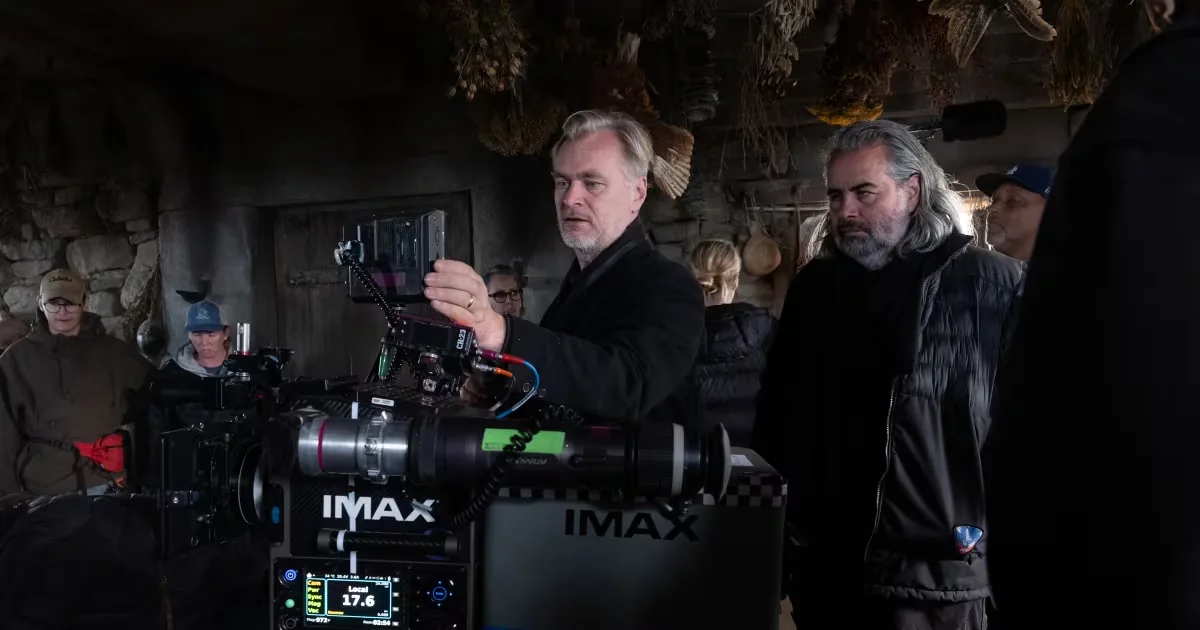
-Why did you choose to shoot on IMAX film, this cinema technology that allows capturing and projecting images with quality and scale superior to traditional format?
I have wanted to shoot a film entirely in IMAX format since I was about 16 years old and first saw documentaries filmed in IMAX in museums. The clarity of the image, the incredible color, the absence of grain, the large screen that immerses you in a truly fundamental way, immediately seemed to me relevant elements for Hollywood blockbusters.
But they are huge and noisy cameras. For this project, I went to IMAX and said: “Can you find a way to make the cameras silent? Because I really want to make the whole film this way.” They designed a high-tech housing in which I could place the camera, a very large housing, but that made it silent. However, you have to change the reels every three minutes. So we told the actors: “Okay, you will have this huge machine in front of your face and will have to stop in the middle of a scene and suspend your emotion while we reload the camera as quickly and discreetly as possible.”
If the actors had not wanted to do it or had not felt it worked for them, we would have approached it differently. But, in fact, I think they found it very exciting. The level of concentration in the performance with those limitations was very intense. If you shoot in a digital format where you can record for hours, you can get good work from the whole crew on set, but at different times. In contrast, when that camera is rolling and everyone is focused, knowing they have limited time and everything must come together at that moment, each technician gives their best and reaches that point of extreme concentration. Every format you choose has advantages and disadvantages; the key is to try to build the script around its advantages.
-And what was the most complicated during filming?
From a physical point of view, being on boats is always extremely difficult in cinema, especially on an old reconstructed vessel sailing in rough waters. But for me, the most difficult scenes to shoot were some quiet scenes, very intense dramatic scenes. It was necessary to get the photography team to understand how to move the camera like any other, when in reality it is 50 times bigger. And then there was the challenge of the actors being able to stay focused despite the interruptions. That was one of the biggest challenges of the film.
Read more The French center-right adjusts its strategy in response to Le Pen’s advance ahead of 2027