








It’s supposed that when a long-term boyfriend breaks up with you, you should dream about him. About what was said or not said, about those absent hugs, about those kisses that won’t return, and about the words we’ll never speak again. But I keep dreaming about her.
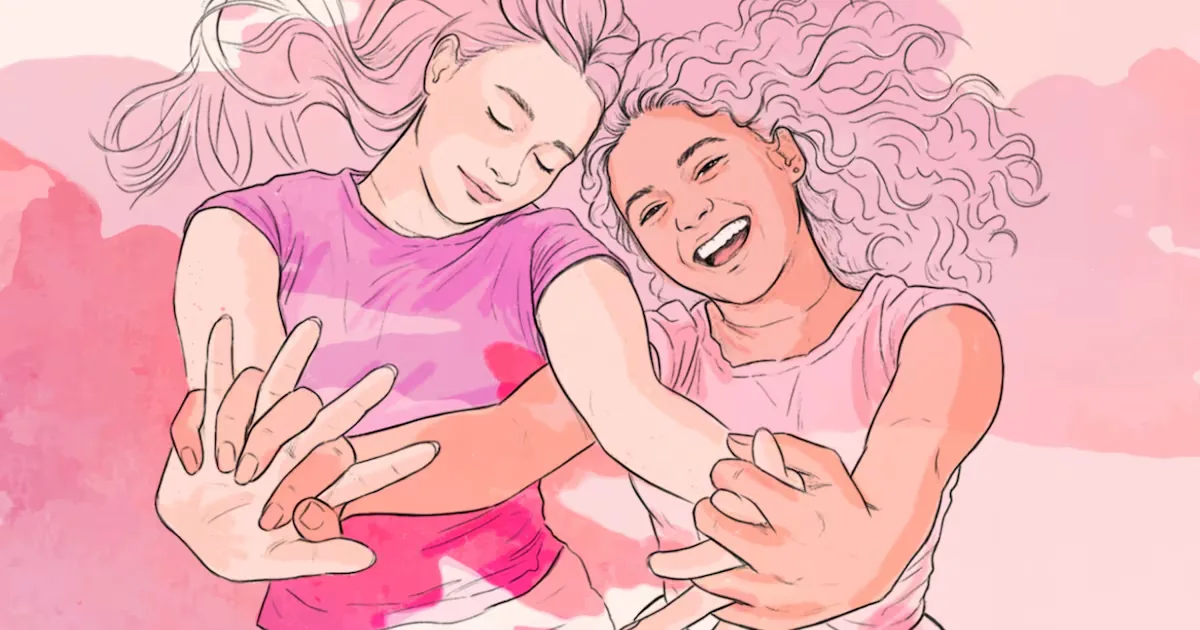
The dream always starts the same way: I go to a cafe whose name and address I don’t remember. The sky is pink, like those days in Santiago after the rain. I want something sweet. I don’t know who is with me. Then she appears, with her curls tied back in the ponytail she always used to hold them, and her brown, glowing skin. She’s the one who works at the place. She sees me and smiles. Her smile is still exactly as I remember it: perfect.
It’s her. It’s my best friend from school.
The last time I saw her was in 2006. It’s strange because she looks more like a woman, more mature, but I can still see the girl I met in a classroom with sawdust-filled shoes. What do I say to her? It’s hard for me to speak, but, as always, she takes the lead. Then I forget about the sweet treat, about who was with me, and I follow her.
She leads me, and in a flash, I arrive at familiar hallways: our school, the place that made us friends. And as if flying among those pink clouds, we return to our secret places: a corner of the court’s stage, the cafeteria lines to wait for our favorite breakfast (cereal with milk); or behind the tree where she could smoke freely while I ate a sopaipilla with ketchup. All those corners where only she and I have stories.
I ask myself again: what is she doing in my dreams? Where are the others? Only she is there. In the dream, I remember her: she was never afraid. And she taught me that, even if it was with box cutters and threats against those who tried to bother me. I, on the other hand, was that shy and proper girl, but she brought out a part of me that I still didn’t know how to show.
We stayed talking for hours. I try to find traces of the teenager she was: a band patch on her backpack, nails painted black —or some white, covered with correction fluid—, perhaps even that acidic humor that was always so hers. But it’s strange: it’s her and it’s not. And I’m not myself either; I look more like a child. Then she takes my hand again, her nails dig in unintentionally, and we walk together. I don’t know where she’s taking me, but I follow her, as always. That’s how our friendship was. I would have followed her even blindfolded.
I think about all those lost years. I want to hug her, but I end up overwhelming her with questions. I look at the sky, I look at the school, and then I know I’m going to wake up.
And I’m myself again, in this body, in this life. I search for her online and can’t find her, because I only knew two of her names. How was that possible? She was my best friend. I get anxious and search again for images of that school, but it’s no longer the place I remember. I think I want to talk to her, that my heart is broken, that I want her to make me laugh to get over the sadness, like we used to do when the kids laughed at us. I think of Karina, my best friend from school.
I find nothing online, but in the old trunk in my teenage room, there are still the letters we wrote to each other for our birthdays or important dates: semester endings, summer and winter vacations. I read them and even smell them. The writing is funny, very “pokemona” and sometimes a bit “emo,” with many capital letters and some “z”s instead of “s”s.
I think of those smiles and those complicit glances from childhood. The letters hint at something: each year I wrote as if I wasn’t sure I’d see her again. It was an intuition, one of those certainties that arrive without explanation. Perhaps she doesn’t know who I was, or perhaps she forgot me as any child would. Maybe she didn’t keep our letters; they probably got lost. I don’t care, at least I have something of her.
And so, when I wake up from that repetitive dream, I remain still and think a lot about that time. Shocks always wake you up.
I suppose that, just as she rescued me from tedious recesses, from the kids who made fun of us, and even from math teachers, she somehow continues to do so. Only now, the place she comes back to find me is not the schoolyard, but my dreams.
Read more U.S. Magistrate sets start of drug trafficking trial against Nicolás Maduro for June 1, 2027