









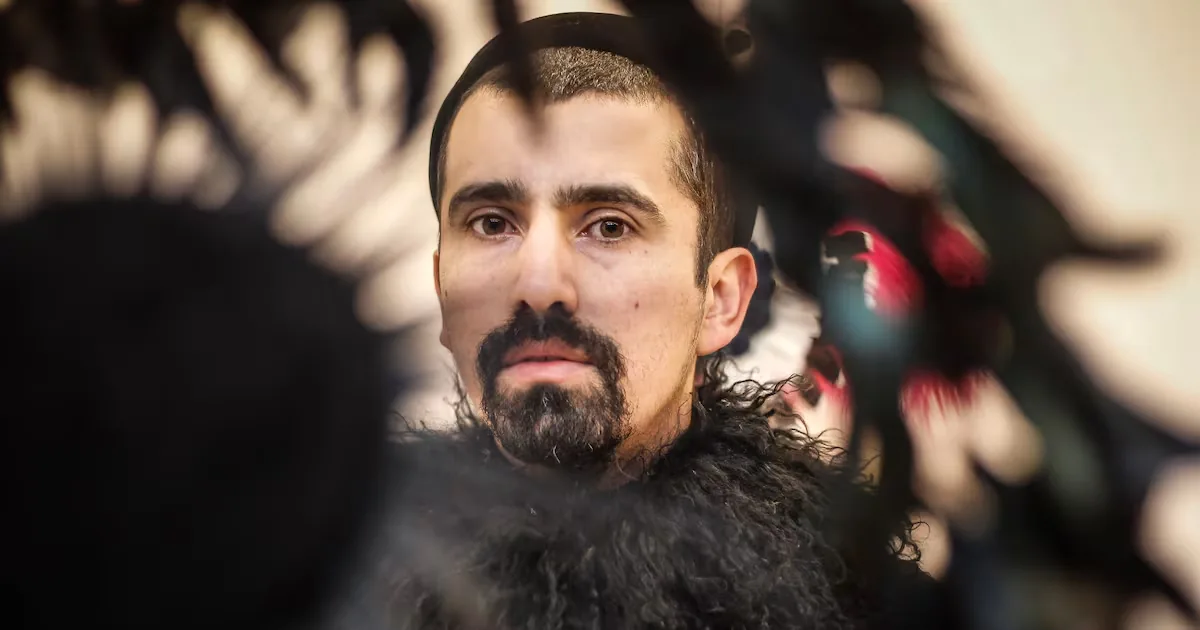
As a child, he didn’t want to be an astronaut or a soccer player. While others dreamed of putting out fires or traveling to space, Juan dreamed of being a bird. His universe revolved around dinosaurs, birds, and animals. He spent hours watching documentaries, leafing through encyclopedias, and visiting museums.
Read more Six dead and two injured in a shooting in Guatemala City
The curious thing is that the creativity and manual dexterity that define his work today were not an innate skill. In school, plastic arts were precisely the subject where he had the most difficulties. Concerned about this, his mother began to encourage him by buying him plasticine, tempera paints, and different materials so he could practice at home. “Thanks to my mom, and over time, I started to like the arts in general,” he recalls. No one would have imagined then that this child, who once needed to strengthen his artistic skills, would end up building a career as one of the most recognized hatmakers and headpiece creators in the Chilean scene.
After leaving school, Juan Eduardo Cabezas (35), better known as Juan, the Colorblind, knew he wanted to dedicate himself to something related to the arts, but he also sought a profession that offered stability, so he chose architecture, “which is a bit of both,” he says.
It was at the Faculty of Architecture of the University of Chile where the creator he is today began to take shape. Among models, structures, and composition exercises, the nickname that would eventually become his brand also appeared.
Juan had lived his whole life with color blindness, but he had never felt it as a limitation. At university, however, color perception became a daily challenge. “In Architecture, it’s terrible, because you had to be very precise with color. It’s not that you change all colors, as people sometimes think; it’s certain shades that your eye doesn’t distinguish. For me, it happens with cool colors, for example,” he explains.
The situation ended up becoming a recurring joke among his classmates, who began to call him Juan, the Colorblind.
But he, far from understanding color blindness as a disadvantage, decided to incorporate it into his way of creating. “I’ve always seen it more as a plus. It’s like having a filter always with you; if I didn’t have it, I would be a different person creatively,” he states.
That particular way of looking at the world runs through his work. His headpieces rarely resort to strident colors to attract attention. Instead, he favors textures, silhouettes, feathers, earth tones, and structures that seem to defy balance.
It all began during one of the most difficult moments in Juan’s life. After years of demanding training in Architecture, where sleepless nights and constant pressure seemed part of the routine, he suffered a severe deterioration of his mental health. “I was doing badly at university, my personal life wasn’t good either, and that’s why I didn’t finish the degree. In fact, I never officially graduated as an architect,” he recounts.
In this context and without a clear direction, he opened an Instagram account to share some of his creations. There was no business plan or intention to become a designer; it was simply a way to keep himself busy. “Within all this depression, within this huge slump where I had nothing to do, I started uploading little things. It was therapy for me”.
He started by publishing drawings, photographs, and small accessories made with cardboard and other simple materials. Since adolescence, he had closely followed the work of international fashion designers, and that influence began to appear naturally in the creations he shared.
One day, a design student found his Instagram account and asked him to create a headpiece for their collection’s end-of-year fashion show. Then came the first editorial photographs, publications in specialized media, and new commissions. Little by little, making hats stopped being a hobby and became his profession.
But, even when his work was already recognized, Juan never felt comfortable calling himself a designer. “I am not a designer. I studied Architecture and didn’t even finish the degree. That’s why I like to say I’m a hatmaker or artisan,” he states.
Read more Rush: “We would never have come back if we didn’t believe we could play better than ever”
For a long time, that definition was a conflict. He felt that his creative process was different from those trained in design schools: “I just made things that occurred to me. I didn’t have that design discipline that seeks to solve a real-world problem. Mine was to create from what I imagined and with the materials I found.” Perhaps that’s why, more than designing accessories, Juan ended up building his own craft: one where experimentation, intuition, and manual work weigh as much as technique.
As he acknowledges, each of his pieces goes beyond the material: “I sell ideas or concepts, rather than headpieces. The headpiece is the medium for that idea, that feeling, that critique to be expressed.” Behind them are hours calculating invisible structures so that a headpiece seems to float above a head. There are tests with unconventional materials inherited from architecture school, where he learned that any element could become creative matter. “Don’t be afraid of materials,” he remembers his teachers repeating, a phrase that continues to guide his work.
In these sculptures, references to art history, religious architecture, and especially birds coexist. And it is that the child who dreamed of being a bird never disappeared. Feathers appear again and again in his collections. Not only as material, but as an extension of that childhood fascination with ornithology.
In fact, one of his most significant collections is driven by that childhood dream. Titled “Octocaudipteryx Daltonicaae,” Juan gave himself space for his creativity to flow without limits and invented four imaginary bird species and built four headpieces inspired by them, with scientific names created together with a Mexican ornithologist and photographs mounted as if they belonged to a natural history museum. “I didn’t ask anyone anything. It was all to please eight-year-old Juan,” he says.
Although he works in one of the most traditional crafts surviving in Chile, Juan insists that hats do not belong to the past. He deeply admires the technique of the old masters, as he himself learned the craft in the historic Sombreros Girardi factory before its closure, but he questions the rigidity with which hatmaking is often understood: “I don’t want to make hats for the 19th century. I want to make hats for the 21st century.”
That’s why his pieces rarely dialogue with period costumes, even when they draw historical references. His intention is different: to demonstrate that a headpiece can be contemporary, that it can coexist with current fashion and cease to be an object reserved for historical reenactments or ceremonies.
Ten years after uploading those first cardboard headpieces to Instagram, Juan’s work reached a new milestone: his first major retrospective. “Dramatic Accent,” open until September 5th at the La Sombrerería Cultural Center, brings together about twenty pieces that span a decade of creation and allow one to follow the evolution of a language where references to religious art, birds, experimentation with materials, and the hatmaking craft coexist.
The exhibition also has symbolic value. It not only represents recognition for a career built entirely self-managed, but it is also held in a space dedicated precisely to preserving and disseminating the tradition of hatmaking in Chile. Through exhibitions, workshops, and cultural activities, the La Sombrerería Cultural Center seeks to keep alive a craft that was once part of everyday life and that today survives thanks to the work of artisans and creators who reinterpret it from a contemporary perspective.
For Juan, exhibiting there has a special meaning. “I always wanted to do an exhibition. I felt it was a much more democratic way to showcase fashion than a runway show,” he explains. Seeing his pieces gathered in a space dedicated to the history and future of hatmaking is, he says, the confirmation that the path that began as therapy ended up becoming a craft capable of dialoguing with heritage and art.
More than a retrospective, “Dramatic Accent” proposes a journey through the creative universe of Juan, the Colorblind, and at the same time, invites us to look at the hat from another perspective, not only as an accessory or an object linked to the past, but as a support for artistic experimentation and a way to keep a traditional craft alive.
__
The exhibition “Dramatic Accent” is available for free visits from Tuesday to Saturday at the La Sombrerería Cultural Center, located at 21 de mayo street #707, second floor, Santiago.
Read more Paloma Valencia: “The people in Colombia were very tired of Petro’s government”