








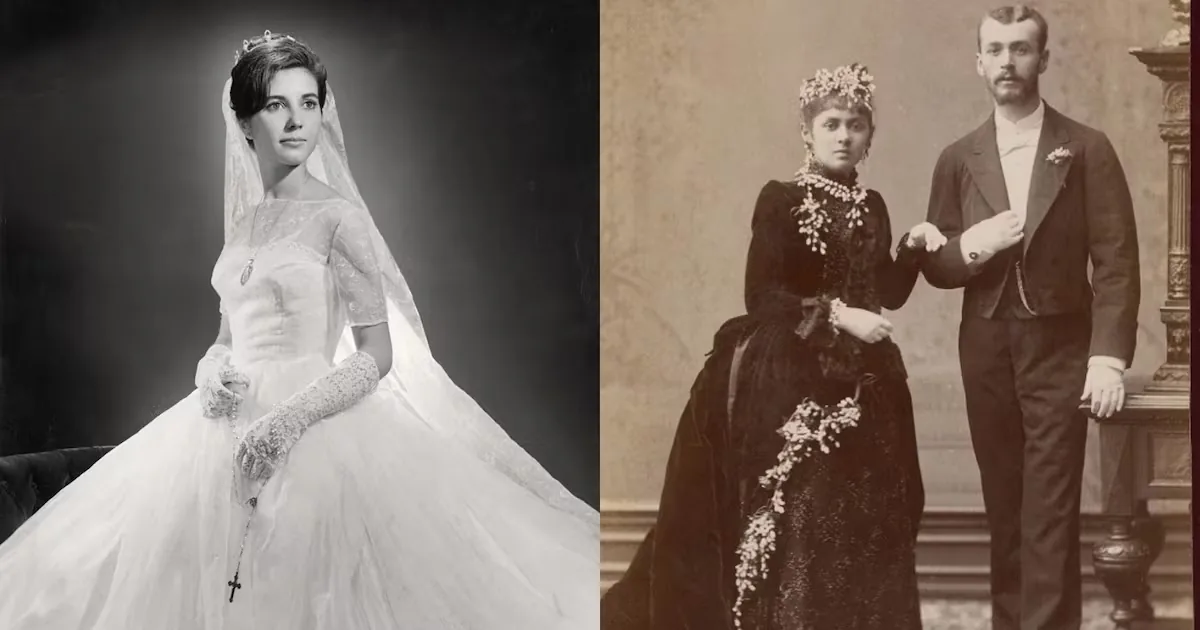
In Chile, marrying in white was not always a tradition: for decades, it was a matter of money. Obtaining a fine fabric in that shade and keeping it immaculate was within reach of very few Chilean families in the 19th century, so it was common to arrive at the altar in black, burgundy, blue, or simply in the best available dress. Black, far from being an economical choice, was often a high-quality piece: it was enough to add a white veil and orange blossom flowers to turn it into a bridal outfit. The ideal of the bride in white arrived from Europe through fashion magazines – after Queen Victoria’s wedding in 1840 – and took decades to become established.
This is one of the findings explored in Brügmann Archive: Photographs of Marriages in Chile 1840–2026, the new research from the Brügmann Heritage Archive. In over 220 pages and with 200 photographs, the book explores what the record of one of the most intimate and collective rituals in its history over 186 years reveals about Chile, its customs, its social classes, and its political moments.
The question that organizes the book is seemingly simple: what can be read in a wedding photograph? The answer, as the research shows, is almost everything. The color and cut of the dress show the era and social class. The staging – whether the photo was taken in a professional studio, at the church door, or during the party – speaks of the codes of each decade: until the mid-20th century, it was common for newlyweds to interrupt the journey between the church and the celebration to have their formal portrait taken in a photographic studio, a practice that disappeared with the digital age. The chosen church places the family on the social map of their city. The gifts displayed next to the couple reveal the guests’ economy. Even the presence of curious onlookers gathered on the sidewalk – a popular tradition now almost extinct – says something about how marriage was, not so long ago, a collective spectacle.
The photographs that make up the book come from decades of patient compilation by researchers Fernando Brügmann and Mario Rojas Torrejón, founders of the Brügmann Heritage Archive: flea markets, auctions, family attics, donations from heirs who found boxes of images without known faces. They are mostly vernacular and anonymous photographs that, had they not been rescued, would have disappeared forever.
Each image was identified, dated, and, when possible, researched: who its protagonists are, where they got married, what happened to their lives. This archival work is complemented by the historical analysis of historian Magdalena Dittborn Callejas, who explores the legal, economic, and cultural transformations of marriage in Chile.
“More than a simple record, the bridal photograph functioned as a public declaration: it not only documented the union of two people but also the meeting of families, heritages, and life projects,” explains Fernando Brügmann. “For the same reason, they constitute an indispensable visual memory for understanding who we were and who we are,” adds Mario Rojas. “Safeguarding this type of collection is not just an exercise in nostalgia, but also a tool for projecting ourselves into the future.”
Among the most surprising findings is the place women occupied within marriage as an institution. “For much of the 20th century, a married woman was legally considered a ‘relative incapable’,” explains Dittborn. “She depended on her husband even to manage her own assets, a condition that persisted until almost the end of the century.” Thus, the trousseau – the sheets, tablecloths, and bedding that the bride embroidered with initials months before the wedding – was not just a domestic tradition: it was the way the woman prepared, stitch by stitch, the life that the law had already defined for her.
Read more Gianluca starts his new era in a ring with Romina Pistolas
The book also traces how that legal definition changed: from the figure of mandatory civil marriage, to the emergence of the Civil Union Agreement in 2015 and the entry into force of egalitarian marriage in 2022, milestones that radically expanded who could star in that recognizable scene of two people deciding to meet.
And it also explores how celebrations adapted to the most critical political moments: in the 1970s and 1980s, it was common to finish the toast in the mid-afternoon to get home before curfew. “The ritual of marriage, and everything surrounding it, has never been static: it changes in its forms, in its rites, in its ways of being celebrated. It is, after all, a mirror of its time: social, economic, and cultural. And it is precisely there, in those details that shape the celebration, where each era leaves its mark,” emphasizes Dittborn.
Among the documented weddings, some appear with additional historical interest: that of former President Sebastián Piñera with Cecilia Morel on December 21, 1973, a few weeks after the coup, in an intimate ceremony in Santiago; the marriage of former Minister of the Interior Edmundo Pérez Yoma with Paz Vergara Larraín in 1965, attended by former President Eduardo Frei Montalva; and the wedding of visual artist Claudio Di Girolamo with Carmen Quesney Besa in 1955 with a simple breakfast alongside the neighbors of the community where they had met doing volunteer work.
Weddings that share pages with others where, although the bride and groom were not public figures, the photographs documenting the celebration provide equally revealing data and customs. Such as that of a bride who, in the midst of the Unidad Popular era, when fabrics were scarce, made her dress from Chilote wool shawls she found in a CEMA Chile store. Or the wedding of José Padilla Caroca, a 24-year-old Cuasimodista Catholic, and Susana Arriagada Cisternas, a 32-year-old agnostic and socialist militant, who married in the civil registry in 1974 with her dressed in red. “In every wedding, in its gestures and details, there is more than just a party: the reflection of an era,” says Dittborn.
The book closes in 2026 with the marriage of Florencia Ibarra and Benjamín Alcalde, two influencers who, the day after getting married, dressed again as bride and groom to visit the grandparents who had not been able to attend the ceremony. The video of that gesture went viral: a contemporary image that connects directly with something the book shows on each of its pages: that the need to ritualize marriage – to record it, to share it with loved ones – has not changed in over 180 years. What changes, decade by decade, is how.