


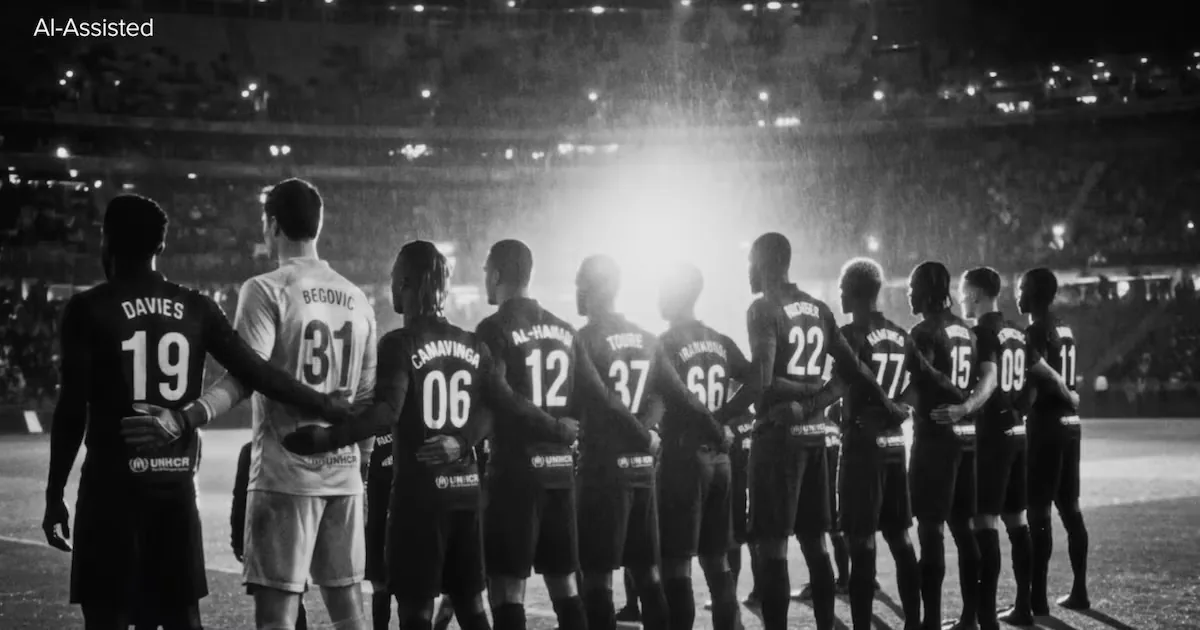
“Affected by forced displacement. Inspiring millions of young people forced to flee. Embodying what is possible.” On the eve of the FIFA World Cup 2026, UNHCR, the UN Refugee Agency, announced the creation of a symbolic team made up of footballers from around the world marked by experiences of refuge and forced displacement.
According to UNHCR, this “Gamechanging Team,” which makes a difference, embodies hope, courage, and resilience, and demonstrates that anything is possible when young people who have fled war and persecution find protection, opportunities, and welcome. “From displaced to unstoppable,” it defines them.
This is a symbolic lineup of players with experience as refugees or displaced persons. “The team highlights the power of football as more than just a game; for young refugees, it can be healing, hope, and a sense of belonging. It has the power to change lives,” emphasizes the initiative’s website.
The team is captained by UNHCR Goodwill Ambassador and captain of the Canadian men’s national football team, Alphonso Davies, born in a refugee camp in Ghana after his parents fled the war in Liberia before being resettled in Canada.
“It is very special to lead UNHCR’s Gamechanging Team, made up of players whose childhoods were marked by war and displacement. We are proof of what is possible when children find safety and opportunities. In times like these, I hope we can convey hope and the conviction that, however difficult the path, it is always possible to overcome it,” declared Davies, 25, a Bayern Munich player.
In March 2021, Alphonso Davies became the first footballer and the first Canadian to be appointed UNHCR Global Goodwill Ambassador. Following his appointment, he stated: “I am proud to join the UN Refugee Agency as a Goodwill Ambassador. My own experiences drive me to speak up for refugees, to share their stories, and to help bring about change.”
“While the refugee camp provided a safe place for my family when they fled war, I often wonder where I would be if I had stayed there and not taken advantage of the opportunities resettlement offered me. I don’t think I would have gotten to where I am today,” he commented.
Alphonso and his family settled in Canada when he was five years old. Despite a difficult start to life, he became a professional footballer at 15 thanks to his dedication and discipline. He debuted with his national team just one year later, becoming the youngest player in the history of the Canadian men’s national team. In 2023, he became the first Canadian footballer to score a goal in a men’s World Cup.
Alongside him is German international Antonio Rüdiger, whose parents fled the conflict in Sierra Leone and found refuge in Germany, the country he represents today.
At 33, the current Real Madrid defender told UNHCR: “My parents came to Germany from Sierra Leone seeking safety and a better future. To represent Germany today is, for me, closing a circle. It is a source of pride, but also a responsibility: to give my best on the field and contribute to making a positive impact off it. Through my foundation in Sierra Leone and organizations like UNHCR, displaced youth and families have greater access to education, sport, and health. Because all children deserve to grow, dream, and succeed.”
Rüdiger grew up in Neukölln, Berlin, in a community largely made up of refugees, where his parents settled after fleeing the civil war in Sierra Leone. According to his own account, it was a difficult area, and football kept him out of trouble.
“We didn’t have phones to call each other and say, ‘Hey, let’s connect.’ No. We just looked out the window, saw some kids playing football, and thought, ‘Let’s go.’ That was the signal. That’s the good thing about Germany: you have football fields everywhere. It’s just that nowadays they’re not used as much because we’re human and we’ve adapted to digital life,” he told the British newspaper The Guardian.
He doesn’t want, he assures, for people to feel sorry for him for having suffered difficulties. Quite the opposite. He remembers a vibrant and united community, with “a lot of solidarity.” “If someone didn’t have enough food or milk, they would visit a neighbor and ask,” he says. “We shared everything. It was that kind of feeling. It was one of the best experiences of my life.”
Rüdiger is the youngest of six siblings. Only he and one of his sisters were born in Germany. The rest fled Sierra Leone shortly after the civil war broke out in 1991 and the Revolutionary United Front attempted to overthrow the government. The conflict lasted 11 years and displaced nearly 2.5 million people, approximately half the population. Villages were destroyed and family members were scattered across different countries.
“My story is an example to others that you can go far starting from nothing. I want to support and motivate young people who are struggling to succeed in life,” Rüdiger told the UNHCR website.
Also part of the team is Asmir Begović, Leicester City FC player, who fled Bosnia at the age of four and represented Bosnia and Herzegovina in their first World Cup. “Being forced to flee home as a child marks you forever. It made me who I am. Football gave me stability, purpose, and a sense of belonging. For young refugees, this sport can keep their dreams alive,” declared the 38-year-old goalkeeper.
Joining Begović is Mohamed Touré, from Norwich City FC, born as a refugee in Guinea and resettled in Australia, whose national team he defends today. “My family arrived in Australia as refugees. Sport gave me freedom, faith, and a sense of belonging. I hope that by sharing my story, I show young refugees that their starting point in life does not define what they can achieve,” said the 22-year-old center-forward.
Also featured is Ali Al-Hamadi, from Luton Town FC, who fled Iraq to find safety in the United Kingdom and has helped his country qualify for its first World Cup in 40 years. The 24-year-old forward told the UNHCR website: “My parents fled Iraq when I was very young. They packed everything, a new country, a new language. I owe them everything. I want to remind everyone that there is always a light at the end of the tunnel.”
Ermedin Demirović, from VfB Stuttgart, has a similar story. His father fled Bosnia at the start of the conflict and rebuilt his life in Germany. Ermedin was born and raised there, and he represents Bosnia and Herzegovina, contributing to the country’s second World Cup qualification. “This UNHCR team demonstrates the power of football to change lives. My father fled Bosnia during the war, and I was born in Germany. To now represent Bosnia and Herzegovina in their second World Cup fills me with pride,” admits the 28-year-old forward.
The parents of Eduardo Camavinga (23), a Real Madrid player, experienced war in Angola before starting a new life in France, the country whose national team he currently plays for. Camavinga was born in the Angolan city of Miconge. His parents had arrived there fleeing the war climate in Brazzaville, capital of the Republic of Congo. In 2003, with the Angolan civil war, perhaps the longest-lasting conflict on the African continent, fueled by the Cold War, his parents, Celestino and Sofia, decided to emigrate to France with their four children.
After a brief stay in Lille and Amiens, the family settled in Fougères, a city in French Brittany 50 kilometers from Rennes, where the player would begin his football career.
War was not the only tragedy Camavinga faced during his childhood. After emigrating to Europe in search of a better future, the footballer’s first years in France did not help improve his situation. At just 10 years old, his family lost everything due to a fire that broke out in the modest house where he lived with his parents and siblings.
The fire incinerated all the belongings of the Real Madrid player and his family: “We had been in that house, which my parents had built with their effort, for less than a year. I remember the fire as if it were yesterday. I was at school and, through the window, I saw firefighters pass by. At the end of class, the teachers approached me and my little sister and told us. My father came to pick us up and took us there; everything was destroyed, everything burned,” Camavinga recounted in an interview.
In the midst of all this misfortune, the Spanish newspaper ABC points out, Camavinga’s father told him one of the phrases the young footballer remembers most: “Don’t worry, you’re going to be a great footballer and you’ll rebuild this house“
Although he is part of the UNHCR team, Camavinga was not considered by coach Didier Deschamps for the France national team squad. “He’s coming off a difficult season where he’s played less, and he’s still young (23 years old),” he justified.
The UNHCR team is completed by: Victor Moses, from FC Kaisar, who fled Nigeria to the United Kingdom and went on to represent his home country; and Awer Mabil, from CD Castellón, born in the Kakuma refugee camp and a World Cup player for Australia.
Alongside them are Nestory Irankunda, from Watford FC, born in a refugee camp in Tanzania and resettled in Australia, a country he is part of the international team for; and Bernard Kamungo, from FC Dallas, raised in a refugee camp in Tanzania before being resettled in Texas (United States). He has represented the US national team on several occasions.
Many of these footballers will be present on the pitches of the next World Cup, which will be held in Canada, Mexico, and the United States starting next June 11.
In a world marked by conflicts, where over 117 million people have been forced to flee their homes, UNHCR’s Gamechanging Team symbolizes what can be achieved when young people find protection and opportunities. “United on and off the field, its members represent a message of hope and join UNHCR’s call to demand safety and opportunities for the 48.8 million displaced children worldwide,” notes the United Nations agency responsible for helping and protecting refugees, forcibly displaced communities, and stateless persons, as well as facilitating their voluntary repatriation, local integration, or resettlement in a third country.
UNHCR highlights that, “with the largest men’s World Cup in history capturing global attention this summer (northern hemisphere), these players are committed to using their visibility to share their stories – from childhood to the present day – and show their support for young people who have been forced to flee.”
The UN High Commissioner for Refugees, Barham Salih, commented: “This summer will see the largest men’s football World Cup in history. It is an ideal moment for UNHCR’s Gamechanging Team to send a message of hope to fans around the world. Each of its members has overcome adversity to fulfill their dreams, and they are a powerful reminder of what displaced young people can achieve when they find protection and are given opportunities.”
Read more Ayatollah Mojtaba Jamenei proclaims Iran’s victory over the United States and Israel